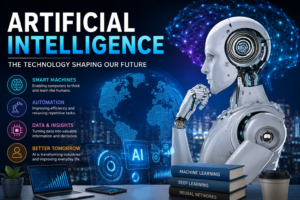
Artificial Intelligence in 2026: How AI Is Changing the Way We Work and Live
Artificial Intelligence is no longer something that belongs only in science-fiction movies or research laboratories. It has quietly become part of everyday life, from the apps people use on their phones to the software businesses rely on to write, analyze, search, and automate tasks.
But something interesting is happening in 2026.
AI is moving beyond simple chatbots and basic question-and-answer tools. New systems are increasingly designed to understand goals, work through multiple steps and, in some cases, take actions with limited human intervention. This shift toward AI agents is becoming one of the most important developments in the technology industry.
So, what exactly is Artificial Intelligence, where is it heading, and how could it affect ordinary users?
Let’s take a closer look.
What Is Artificial Intelligence?
Artificial Intelligence, commonly called AI, is a field of technology focused on creating computer systems that can perform tasks that normally require human intelligence.
These tasks can include:
- Understanding language
- Recognizing images and sounds
- Finding patterns in information
- Generating text, images, audio, and video
- Making predictions
- Solving problems
- Supporting decisions
- Automating repetitive work
Modern AI systems can process huge amounts of information much faster than a person can. However, that does not mean AI understands everything in the same way a human does.
The quality of an AI response still depends on the model, the information available to it, the instructions it receives, and the way the system has been designed.
Why Is Artificial Intelligence So Important in 2026?
The biggest change is that AI is becoming more practical.
A few years ago, much of the excitement around generative AI focused on producing text, answering questions, and creating images. Today, organizations are increasingly experimenting with AI across real business processes.
McKinsey’s 2026 State of AI research reports that organizations are expanding AI use across more business functions, including coding agents and systems capable of carrying out tasks across workflows.
That means the conversation is gradually changing from:
“What can AI generate?”
to:
“What can AI actually do for me?”
That difference is important.
The Rise of AI Agents
One of the biggest Artificial Intelligence trends in 2026 is the rise of AI agents.
A traditional chatbot generally waits for a question and then produces an answer. An AI agent can be designed to understand a goal, break it into smaller steps, use connected tools,s and work through a task.
For example, instead of simply asking an AI system to explain a spreadsheet, a future AI workflow could potentially analyze the data, identify unusual figures, prepare a summary and create a report.
Google Cloud describes this shift as a move from individual prompts toward AI systems that can orchestrate more complex workflows.
This does not mean humans are disappearing from the process. In many real-world applications, human oversight remains essential.
Generative AI Is Still Growing
Generative AI is another major part of the Artificial Intelligence landscape.
Unlike traditional software that follows predefined instructions, generative AI can create new content based on patterns learned from large datasets.
Depending on the system, it can generate:
- Articles
- Emails
- Images
- Videos
- Computer code
- Presentations
- Summaries
- Audio
- Translations
The technology is also becoming increasingly multimodal, meaning modern AI systems can work with different types of information rather than relying only on text. Gartner identifies multimodal capabilities, smaller reasoning models, and agentic AI among important forces shaping the next phase of generative AI adoption.
How Artificial Intelligence Is Changing Work
AI is already changing the way many people approach their daily work.
A writer can use AI to brainstorm ideas. A programmer can use coding assistants. A business team can analyze large amounts of information more quickly. Customer-service teams can automate some routine interactions.
The real value often comes from combining human judgment with machine speed.
Instead of asking whether AI will do everything, a more useful question is:
Which parts of a job can AI handle better, while people focus on the parts that require experience, responsibility, and judgment?
That is increasingly becoming the practical approach to AI adoption.
Artificial Intelligence in Everyday Life
You may already use AI without thinking about it.
AI can appear in:
- Search engines
- Smartphone cameras
- Navigation apps
- Recommendation systems
- Spam filters
- Translation tools
- Voice assistants
- Social media feeds
- Online shopping
- Photo editing applications
For example, when a phone automatically improves a photograph or a streaming service recommends something you might enjoy, AI-powered systems may be working behind the scenes.
The technology is often invisible because the best AI features are designed to feel like normal parts of an application.
AI in Business
Businesses are investing heavily in Artificial Intelligence because automation can save time and help employees handle large amounts of information.
Common business applications include:
Customer Service
AI systems can answer common questions, organize customer requests, and help support teams find information faster.
Marketing
AI can assist with content ideas, audience analysis, personalization and campaign planning.
Software Development
AI coding tools can help developers write, review and explain code.
Data Analysis
AI can identify patterns in large datasets and help people turn raw information into useful insights.
Cybersecurity
AI can help security teams identify unusual activity and prioritize potential threats.
The move toward AI agents is particularly interesting because businesses are beginning to explore systems that can operate across multiple steps rather than performing one isolated task.
AI Is Not Perfect
The rapid growth of Artificial Intelligence should not hide its limitations.
AI systems can produce incorrect information, misunderstand context, or make confident statements that are not supported by reliable evidence.
This is especially important when dealing with:
- Medical information
- Financial decisions
- Legal matters
- Government information
- Security
- Personal data
AI should therefore be treated as a powerful tool rather than an unquestionable source of truth.
For important decisions, information should be checked against reliable primary sources.
AI and the Future of Jobs
One of the biggest questions surrounding Artificial Intelligence is what it means for employment.
The answer is more complicated than simply saying that AI will either destroy or create jobs.
Some tasks are likely to become increasingly automated, while other roles may change as workers learn to use AI effectively.
Interestingly, McKinsey’s 2026 research found that among organizations using AI, only 14% of respondents reported that AI had contributed to an overall decline in workforce size during the previous year.
That does not mean job disruption is impossible. It suggests that the real impact may depend heavily on how organizations implement AI and how quickly workers adapt.
AI Skills Are Becoming More Valuable
As AI becomes easier to access, knowing how to work with it may become an important digital skill.
People do not necessarily need to become AI engineers.
For many users, useful skills include:
- Writing clear instructions
- Checking AI-generated information
- Understanding basic AI limitations
- Protecting personal information
- Using AI tools efficiently
- Combining AI with existing software
- Reviewing AI-generated content before publishing
In other words, AI literacy may become as useful as basic computer literacy has been for previous generations.
What Is the Future of Artificial Intelligence?
The next stage of AI is likely to focus less on impressive demonstrations and more on useful results.
AI systems are becoming more capable of handling multiple forms of information, working with external tools and supporting longer workflows.
At the same time, businesses are paying greater attention to security, governance, cost and reliability.
Research from the AI industry shows that organizations are already moving toward production AI agents, while reliability and observability remain important challenges.
The future of AI, therefore, may not simply be about making models bigger.
It may be about making them:
More useful.
More reliable.
More connected.
More efficient.
And safer to use.
Artificial Intelligence: What Users Should Expect in 2026
For ordinary users, the biggest change may be that AI becomes less noticeable.
Instead of opening a separate AI website every time they need help, people may find AI features built directly into phones, search engines, office software, browsers and other applications.
This could make technology feel more personalized and automated.
However, convenience will also create new questions about privacy, security, accuracy, and human control.
As AI becomes more capable, knowing when to trust it—and when to double-check it—will become increasingly important.
Final Thoughts
Artificial Intelligence has already moved beyond being a futuristic idea. In 2026, it is becoming a practical part of work, business, software,e and everyday digital life.
The most important development may be the shift from AI that simply responds to requests toward systems that can help complete larger tasks and workflows. AI agents, generative AI and multimodal technology are all contributing to this change.
But the future of AI will not depend on technology alone.
Human judgment, responsible use, privacy and proper oversight will remain just as important.
The people and organizations that learn how to use Artificial Intelligence effectively—without blindly trusting it—are likely to get the most value from this rapidly changing technology.
Frequently Asked Questions
What is Artificial Intelligence?
Artificial Intelligence is technology that enables computer systems to perform tasks associated with human intelligence, such as understanding language, recognizing patterns, generating content and solving problems.
What are the main types of AI being used today?
Modern AI includes machine learning, generative AI, natural language processing, computer vision, and increasingly AI agents that can perform multi-step tasks.
What is generative AI?
Generative AI refers to systems capable of creating new content such as text, images, audio, video and computer code.
What are AI agents?
AI agents are systems designed to understand goals, plan steps, use tools, and perform actions with varying degrees of autonomy. Their capabilities and level of human oversight differ by system.
Will Artificial Intelligence replace human workers?
AI is likely to automate some tasks and change many jobs, but the overall impact varies by industry and role. Human judgment, creativity, communication,n and responsibility remain important.
Is Artificial Intelligence safe to use?
AI can be useful, but it is not perfect. Users should verify important information, protect sensitive data, and avoid treating AI-generated answers as automatically correct.
Why is AI becoming more important in 2026?
AI is becoming more deeply integrated into everyday software and business processes. The growing use of generative AI and AI agents is pushing the technology beyond simple question-and-answer interactions toward more practical workflows.